

Confirm the study brief
Define each location, observation boundary, date, period, movement, road-user class, reporting interval and required output before counting begins.
Service 02
Human-led traffic counts and recorded-video processing, structured around agreed movements, classes, lanes, intervals, QA/QC and delivery requirements.
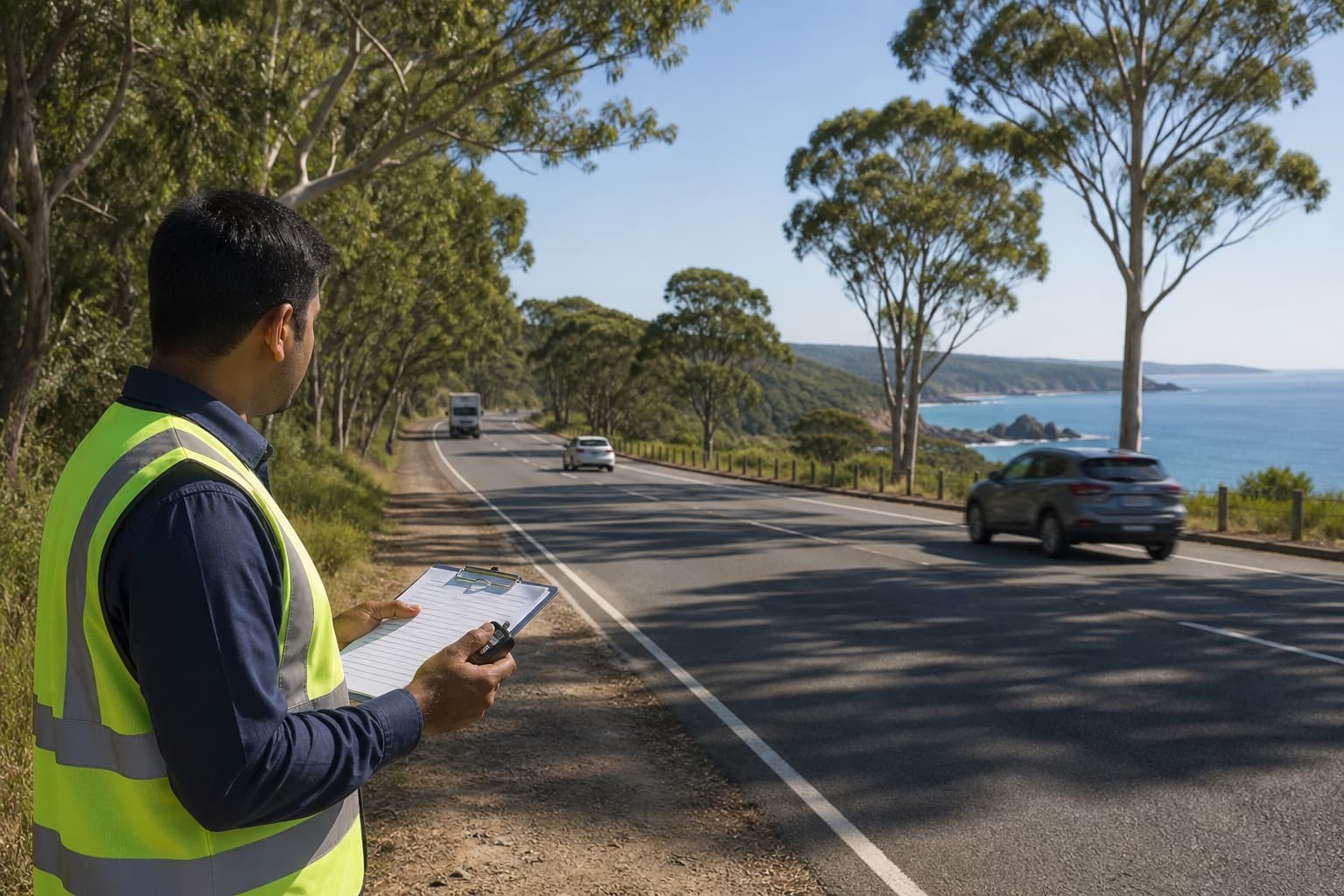
How the study is observed
This original conceptual diagram illustrates the study structure. The exact methodology is confirmed against the approved project brief, available source material and local requirements.
Manual traffic count workflow
Manual traffic counting is a human-led review process. The analyst follows a written study matrix, applies the agreed movement and classification rules, and converts visible events into traceable interval data. It is not presented as automated or AI-based counting.
Define each location, observation boundary, date, period, movement, road-user class, reporting interval and required output before counting begins.
Review a representative video clip or field plan to confirm that count lines, approaches, lanes, crossings and class cues are observable.
Human analysts apply the approved movement matrix and class dictionary consistently, recording only what the source can support.
Observations are organised by the required combination of site, direction, approach, lane, movement, class and time interval.
Coverage, interval continuity, labels, movement logic, totals, exceptions and output structure are checked against the brief.
Quality-reviewed tables, summaries and notes are prepared as spreadsheet-compatible data, CSV or an agreed client template.
What can be counted
A useful count is more than a total. The scope selects only the dimensions needed by the study, then defines them before production so every site and interval follows the same rule.
Intersection, roundabout, road link, crossing, parking area, station or another defined observation area.
Left, through, right, U-turn, entry, exit, circulating, directional or project-specific movement rules.
Passenger, commercial, heavy vehicle, bus, motorcycle, pedestrian, bicycle or a written client-defined scheme.
Lane or lane-group reporting where the geometry, brief and source visibility make it dependable.
Agreed intervals—commonly 5, 15, 30 or 60 minutes—plus any peak or study-period summaries required by the project.
Pedestrian and cyclist crossings, routes or directions where they are explicitly included in the observation matrix.
Traffic count outsourcing
A project team or survey company can supply recorded footage after the scope is agreed. Files move through an approved secure-transfer workflow—not the public enquiry form—and the resulting data can be aligned to the client’s labels and output structure without publishing or reproducing a private template.
Client records approved footage
Secure transfer is arranged
Source coverage is checked
Analysts complete manual review
QA/QC is applied
Structured output is delivered
Video and source requirements
Camera position, field of view, stability, resolution, timestamp continuity, lighting, weather, obstructions and vehicle overlap determine what can be counted reliably. Roundabouts may need more than one view to cover entries, exits and circulating movements. A hidden class cue or movement is handled through the agreed exception rule rather than guessed.
Turnaround considerations
Programme planning depends on footage duration, number and complexity of sites, movement and lane detail, class scheme, reporting interval, source quality, exception volume, required checks and output format. Timing is confirmed after source and brief review; the page does not promise a universal completion period.
Confidentiality boundary
Footage and private project files are handled only through the approved project workflow. Public examples are independently generated, synthetic and contain no client data.
Deliverables and client templates
Outputs can be prepared as structured tables, Excel-compatible workbooks, CSV, movement matrices, classification summaries and concise QA/QC notes. When a client has an agreed template, its field names, ordering and aggregation rules can be scoped without exposing the source document publicly.
Study at a glance
Design a repeatable observation plan around the decision, locations, periods and data dictionary.
Typical outputs
Review focus
From observation to structured data
Source
Count
Classify
Aggregate
QA/QC
Deliver
A traffic data collection plan defines what is observed at each location before survey activity starts.
Use it to establish a repeatable evidence base for planning, design, operational or safety questions.
The brief fixes the observation boundary, dates, periods, modes, movement rules and delivery template.
Provide locations or plans, survey question, timing, class scheme, modes and outputs.
Record only the agreed movements, directions and road-user categories.
Set reporting intervals and peak windows before collection so all sites follow the same rule.
Approved data tables, site/method notes, coverage record and agreed supporting outputs.
Check site coverage, time continuity, definitions and workbook structure before release.
A collection method answers only the scope observed; it is not a substitute for a future-demand study.
Sensitive project material is exchanged through approved workflows.
Include the decision, locations, dates, periods, modes, class rules and required delivery format.
Where suitable footage is supplied, remote observation may be scoped; the source must show the required movements clearly.