
Service summary
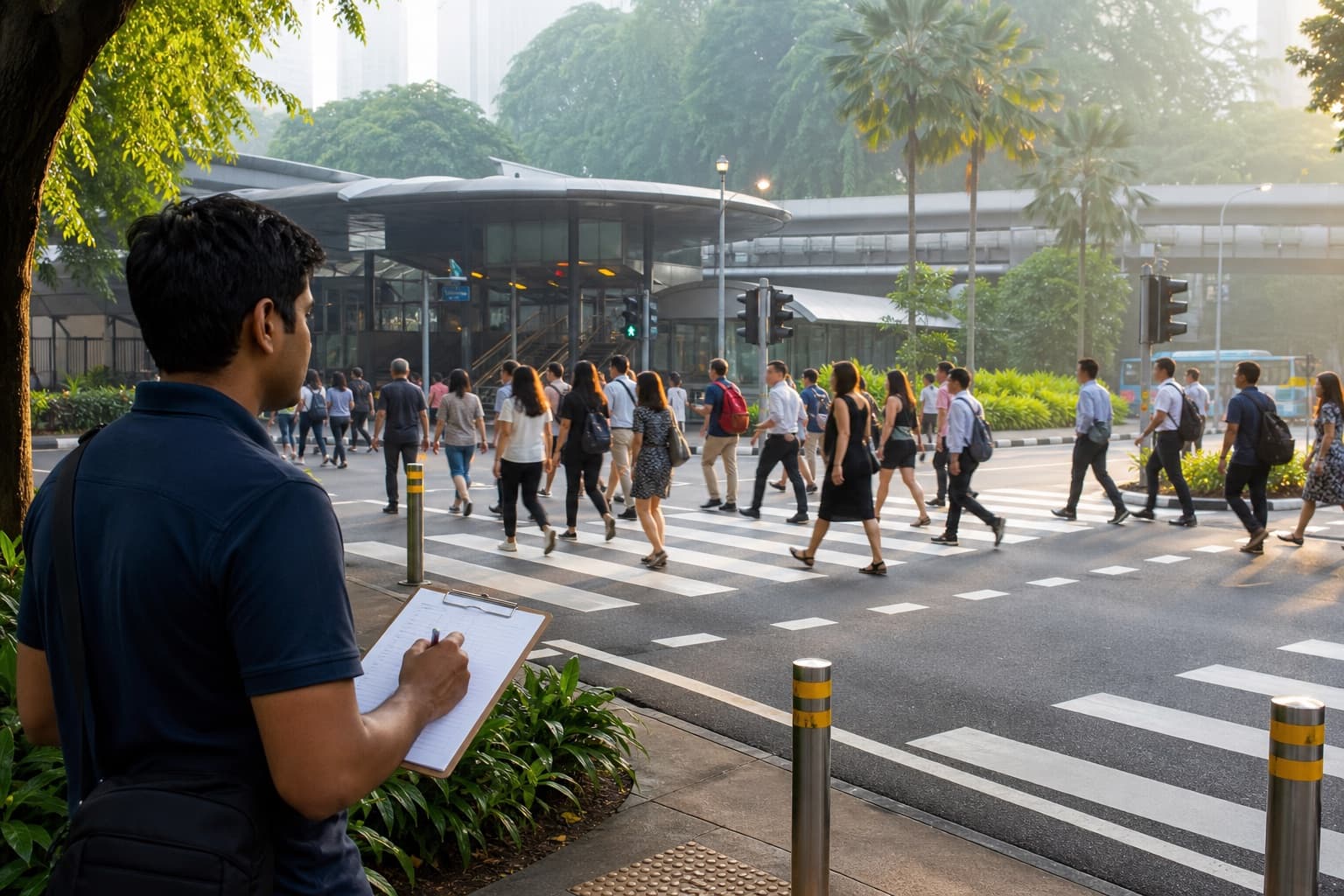
Pedestrian counts measure people crossing or passing a defined screenline, crossing or facility.
When it is used
Use them for active-travel, access, public-realm and safety projects.
Methodology
Set the count line, direction rules, treatment of waiting people and mode boundaries before observation.
Inputs and source requirements
Provide a plan, crossing/screenline, directions, timing, any classes and output needs.
Movements and classifications
Record the approved directional crossing or route movement without double-counting within the observation area.
Time intervals
Use agreed intervals at every count point.
Typical deliverables
Directional pedestrian tables, site references, mode notes and QA record.
Quality control
Review count-line logic, coverage and periods with unusually high flow.
Limitations
Observed footfall is not a complete measure of demand or safety performance.
Privacy and security
No personal identity data is required for a standard pedestrian count.
Frequently asked questions
Can crossings and approaches both be included?
Yes, if each observation boundary is mapped and the movement rules are explicit.
Are people identified?
No. A standard pedestrian count records movements, not personal identity.
Can waiting people be separated from crossings?
Yes, when the observation boundary and treatment of waiting people are stated in the brief.
Can pedestrian counts support safety decisions?
They provide observed movement evidence; a complete safety assessment needs additional context and analysis.