
Traffic Data Count · Classification service
Vehicle classification from traffic video.
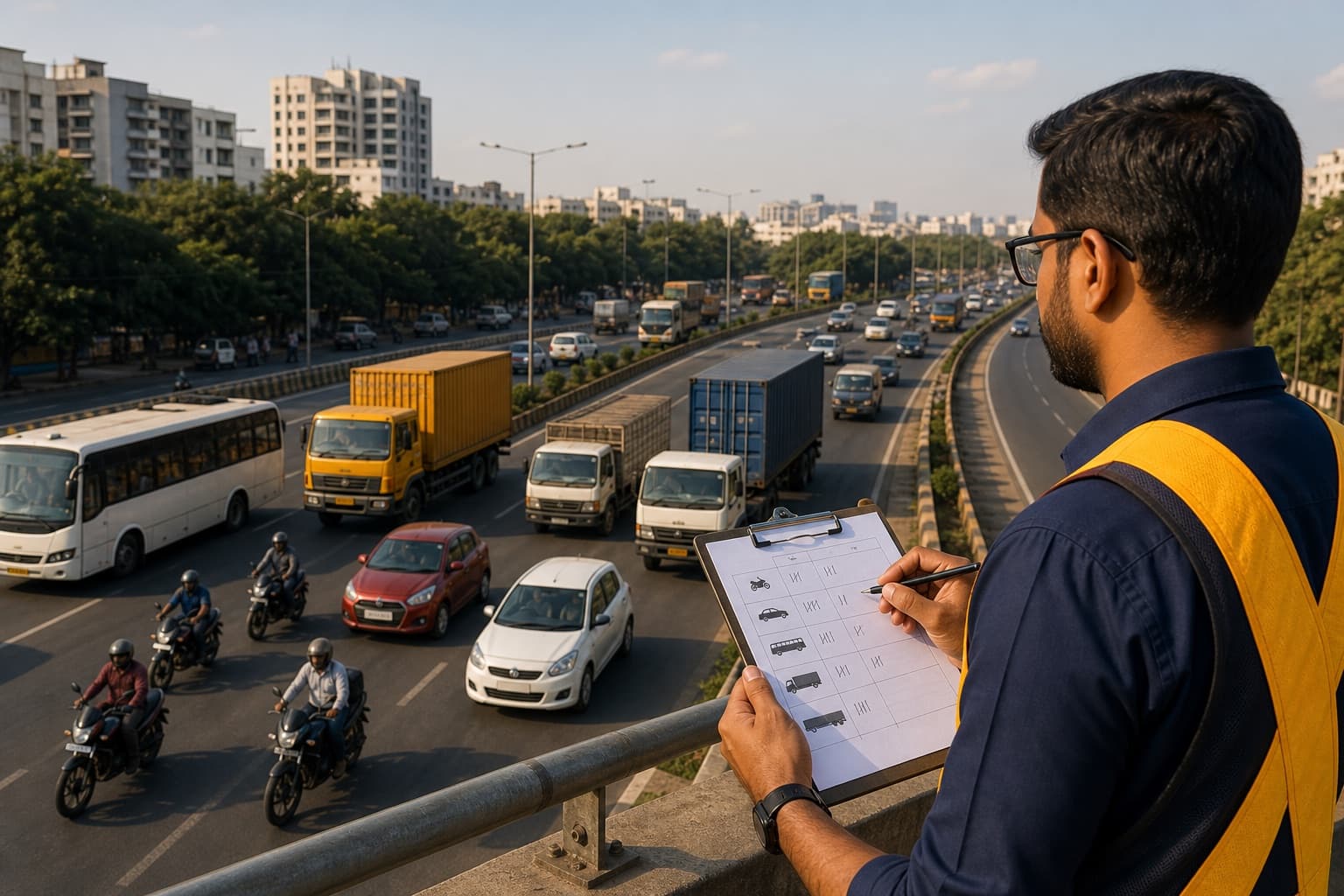
Turn supplied traffic footage into a project-defined record of cars, commercial vehicles, buses, trucks, active travel and other agreed classes—organised by the movements and intervals your decision requires.
Short answer
What is vehicle classification?
Vehicle classification separates observed road users into defined categories so traffic professionals can understand traffic composition, heavy-vehicle activity, modal distribution and other characteristics. The classification may vary by country, authority, client, study and project objective. A useful result therefore starts with a written class dictionary and reports only distinctions that the footage can support.
Core principle
No universal class list is assumed.
The approved project rule controls the labels, edge cases and output columns. If a characteristic is not observable, it is not invented.
What can be classified
A flexible observation vocabulary, shaped to the brief.
Two-wheelers & micromobility
Light vehicles
Public transport
Heavy & commercial
These are illustrative families, not a promise that every project uses every class. The final scheme is agreed against the client’s requirements and the visible evidence.
Recorded-video workflow
From footage to a reviewable classification dataset.
Video footage
Approved footage, site references, dates and time zone establish what can be observed.
Project rules
The client’s classes, movements, lanes, intervals and exception rules are fixed before review.
Observation
Analysts review the agreed observation area and identify each observable road user.
Classification
Each vehicle is assigned only to a class that the source and project rule support.
Aggregation
Direction, movement, lane and interval fields are organised into the requested structure.
Validation & QA/QC
Totals, continuity, exceptions and class consistency are reviewed before delivery.
Custom classification
Use the structure your project already understands.
Clients are not forced into one universal scheme. A brief may ask for light/heavy, light/semi-heavy/heavy, cars/vans/trucks/buses, passenger/commercial, or a detailed combination of vehicle and axle categories. Examples are illustrative; the final dictionary and exception treatment are approved before observation.
Read classification methodology →Project rule
Classes and edge cases
Observation unit
Vehicle, movement or lane
Reporting unit
5 / 15 / 30 minute or hourly
Evidence limit
Only what the source shows
Classification with movements
Add approach, movement and interval context.
At an intersection, classification can be combined with an approach, lane or movement such as left, right, through or U-turn. This creates a classified turning-movement output instead of a single undifferentiated total.
| Approach | Movement | Class | Interval | Count |
|---|---|---|---|---|
| North | Right | Rigid truck | 08:00–08:15 | Illustrative |
Classification on links
Direction, lane and road-section detail.
For a link or mid-block location, the output can be organised by direction, lane, class and time interval. One-way, two-way and multi-lane layouts require different observation boundaries and camera views.
Direction of travel
Lane or lane group
Vehicle class
Time interval
Heavy-vehicle classification
Separate freight and larger vehicles when the evidence supports it.
Rigid truck, articulated truck, semi-trailer, tanker, trailer and multi-axle distinctions can inform traffic engineering, freight planning, pavement studies, road design, intersection analysis and development assessments. Body-type and axle-based rules are not interchangeable; the selected rule must be explicit.
Read the heavy-vehicle authority resource →Rigid truck
Project-defined category; use only when the source view makes the requested distinction dependable.
Articulated / semi-trailer
Project-defined category; use only when the source view makes the requested distinction dependable.
Tanker or trailer
Project-defined category; use only when the source view makes the requested distinction dependable.
Multi-axle vehicle
Project-defined category; use only when the source view makes the requested distinction dependable.
Regional terminology
Formal systems are useful references—not automatic answers.
A classification that works for one authority may not fit another. We use regional references to clarify the brief, then confirm the client’s actual scheme, reporting need and source limitations.
| Region | Useful reference | Practical implication |
|---|---|---|
| USA | FHWA vehicle types | The FHWA 13-category framework ranges from motorcycles and passenger cars to single-unit and combination trucks. Visual footage may not support axle-level distinctions. |
| Australia / New Zealand | Austroads traffic studies guide | Austroads describes multiple classification levels and flexible aggregation. The survey brief should state whether length, axles or vehicle type controls. |
| United Kingdom | DfT road traffic statistics | Published traffic categories include cars and taxis, LGVs, HGVs, pedal cycles, motorcycles and buses/coaches; local project classes may be more detailed. |
| Netherlands / Germany / Europe | Dutch vehicle terminology · German vehicle categories | Terms such as personenauto, bestelauto, vrachtwagen, bus, Pkw, Lkw, Motorrad and Fahrrad can help scope communication; they do not replace an approved count dictionary. |
| Canada / Middle East | Project or authority brief | Confirm local terminology, language, heavy-vehicle treatment and active-travel categories before processing; do not import a foreign scheme by default. |
Visibility context
What the source allows the team to classify.
The recording is reviewed against a project-defined class dictionary. Distance, overlap, glare and the camera angle determine whether a requested distinction can be reported with confidence. The classification workflow and exception rules on this page remain the source of truth; this visual simply illustrates why visibility is assessed before a detailed class is assigned.
On smaller screens, the concise HTML explanation remains available while the text-heavy supporting graphic is withheld to protect readability.

Video quality and limitations
The requested detail must be visible.
Camera angle, height, resolution, field of view, distance, lane width, night conditions, weather, shadows, glare, trees, signs, shake and multi-lane overlap all affect classification. A large vehicle can hide a smaller one; a side view may not show axles; a distant vehicle may not distinguish an SUV from a van.
Quality assurance
Exceptions are documented, not guessed.
- 01Project requirements
- 02Classification rules
- 03Observation
- 04Interval validation
- 05Movement and direction review
- 06Exception review
- 07Final QA and delivery
Intervals and deliverables
Structured for the decision that follows.
Outputs may use 5-minute, 15-minute, 30-minute, hourly, peak-period or daily totals where appropriate to the study. Potential delivery formats include an Excel workbook, CSV, vehicle-class totals, directional or lane-based totals, movement summaries, heavy-vehicle summaries and QA notes agreed in the brief.
Traffic survey reporting →| Time | Direction | Car | Van/LCV | Bus | Rigid | Articulated |
|---|---|---|---|---|---|---|
| 08:00–08:15 | Eastbound | Illustrative | Illustrative | Illustrative | Illustrative | Illustrative |
FHWA reference table
A formal example, kept separate from project-specific reporting.
The following is a compact reference to the FHWA 13-category framework. It is not a claim that every SWAT Alliance project uses FHWA classes, and it is not a substitute for the client’s approved dictionary.
Motorcycles
Passenger cars
Other two-axle, four-tire single-unit vehicles
Buses
Two-axle, six-tire single-unit trucks
Three-axle single-unit trucks
Four-or-more-axle single-unit trucks
Four-or-fewer-axle single-trailer trucks
Five-axle single-trailer trucks
Six-or-more-axle single-trailer trucks
Five-or-fewer-axle multi-trailer trucks
Six-axle multi-trailer trucks
Seven-or-more-axle multi-trailer trucks
Professional applications
Classification that supports the next engineering question.
Frequently asked questions
Before you send recorded footage.
What is vehicle classification?
Vehicle classification separates observed road users into defined categories so a project can understand traffic composition, heavy-vehicle activity, modal distribution and other characteristics. The categories are set by the client, authority, study purpose and source evidence—not assumed to be universal.
Can you classify vehicles from recorded video?
Yes, when the footage shows the required observation area and the requested class cues clearly enough. Camera angle, distance, lighting, overlap and occlusion determine how much detail can be reported reliably.
Which vehicle classes can be counted?
Potential classes include motorcycles, cars, vans, buses, rigid trucks, articulated trucks, trailers, heavy vehicles, bicycles and other agreed road users. The final list is confirmed in the project classification dictionary.
Can we provide our own classification system?
Yes. We can work from a project-defined scheme such as light/heavy, passenger/commercial, car/LCV/bus/rigid/articulated, or a more detailed authority format where the source supports it.
Can heavy trucks be separated?
Potentially. Rigid, articulated, tanker, trailer and multi-axle distinctions can be included when the requested rule and visible evidence make the separation dependable.
Can classification be combined with turning movements?
Yes. A classified turning-movement output can combine approach, left/right/through or U-turn movement, vehicle class, interval and count. See the turning movement count service for the junction-specific method.
Can you provide direction or lane-by-lane classification?
Yes, where the camera view and brief identify lanes or directions clearly enough. A lane-level result is not inferred when vehicles change lanes or are hidden before the relevant decision point.
Can motorcycles, bicycles and e-bikes be separated?
They can be separate fields when the project requires it and the footage supports the distinction. Visually ambiguous micromobility observations should follow the agreed unknown or grouped treatment.
What happens when a vehicle is partially obscured?
The observation follows the project exception rule. It may be grouped into a broader class, marked uncertain, or excluded from a detailed split; the limitation is recorded rather than guessed.
Can you work with FHWA or Australian classifications?
Yes, as a project reference. FHWA’s 13-category system and Australian multi-level approaches are examples of formal frameworks; the selected scheme still needs to match the client brief, location and available source.
Related technical resources
Have recorded traffic footage?
Send the requirements, source details and classification scheme.
Share the locations, footage details, requested classes, movements, time intervals and output format. The SWAT Alliance team can review the scope and clarify what the source can support.