
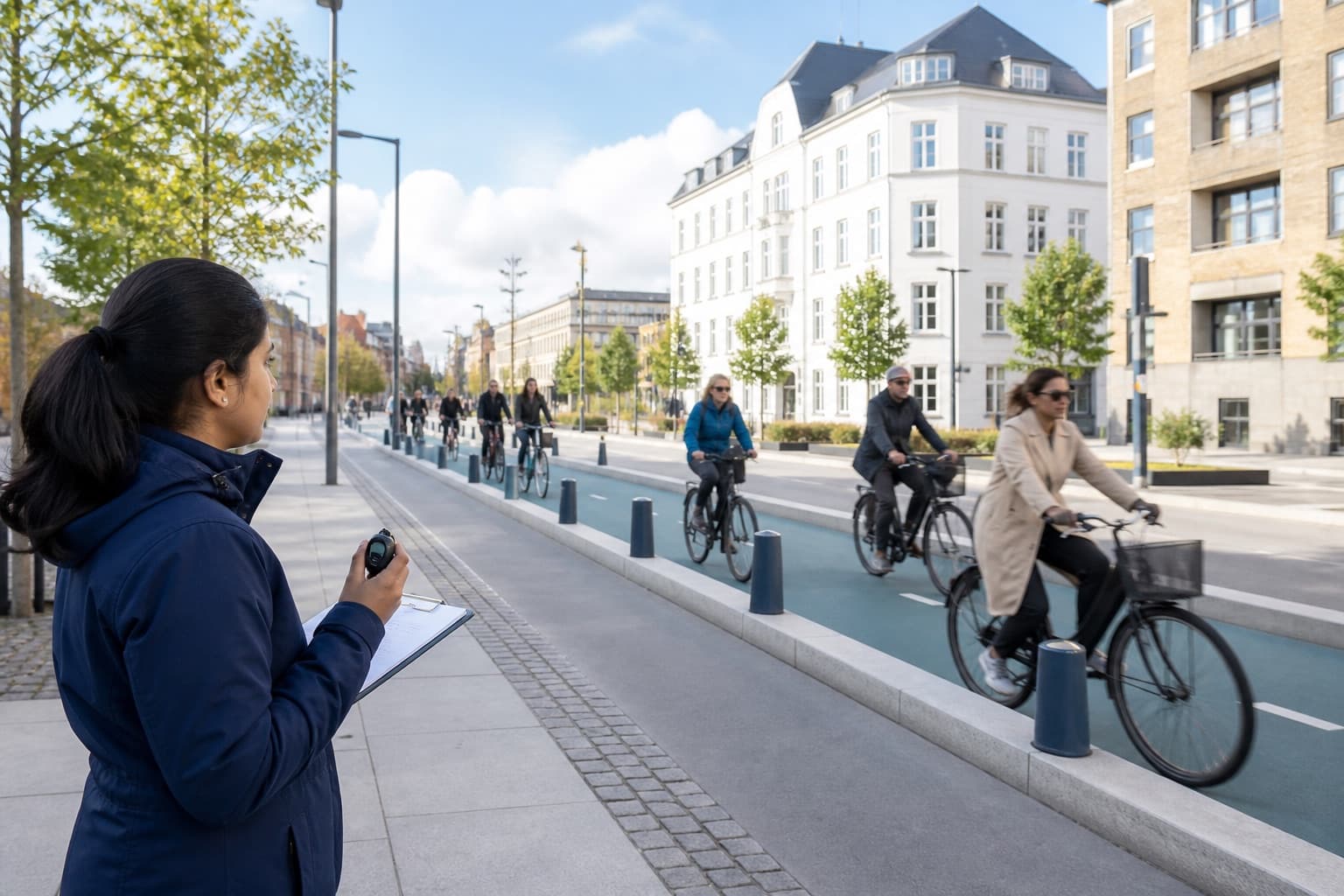
Service summary
Bicycle counts measure cycling movements by direction, route, crossing or interval.
When it is used
Use them for cycle infrastructure, active-travel, access and safety planning.
Methodology
Agree the route/screenline and treatment of e-bikes, scooters and dismounted riders.
Inputs and source requirements
Provide path or crossing plan, directions, times, mode classes and outputs.
Movements and classifications
Record each rider crossing the agreed line or completing the named movement.
Time intervals
Use one agreed interval structure to compare count points.
Typical deliverables
Directional cycle tables, route references and agreed mode-treatment notes.
Quality control
Check shared-path edge cases and totals against the defined treatment rule.
Limitations
A count records use during the observation period and not all potential cycling demand.
Privacy and security
Standard bicycle counts do not require personal data.
Frequently asked questions
Can e-bikes be separate?
Yes when the project requests it and the footage supports a reliable distinction.
Can mixed traffic be counted?
Yes, with a defined count line and treatment of cycles using the carriageway.
Can scooters be included?
Yes, where the project defines micromobility categories and the source supports the distinction.
Can cycle facilities be compared?
Yes, if each facility, direction and period uses the same observation rules.