
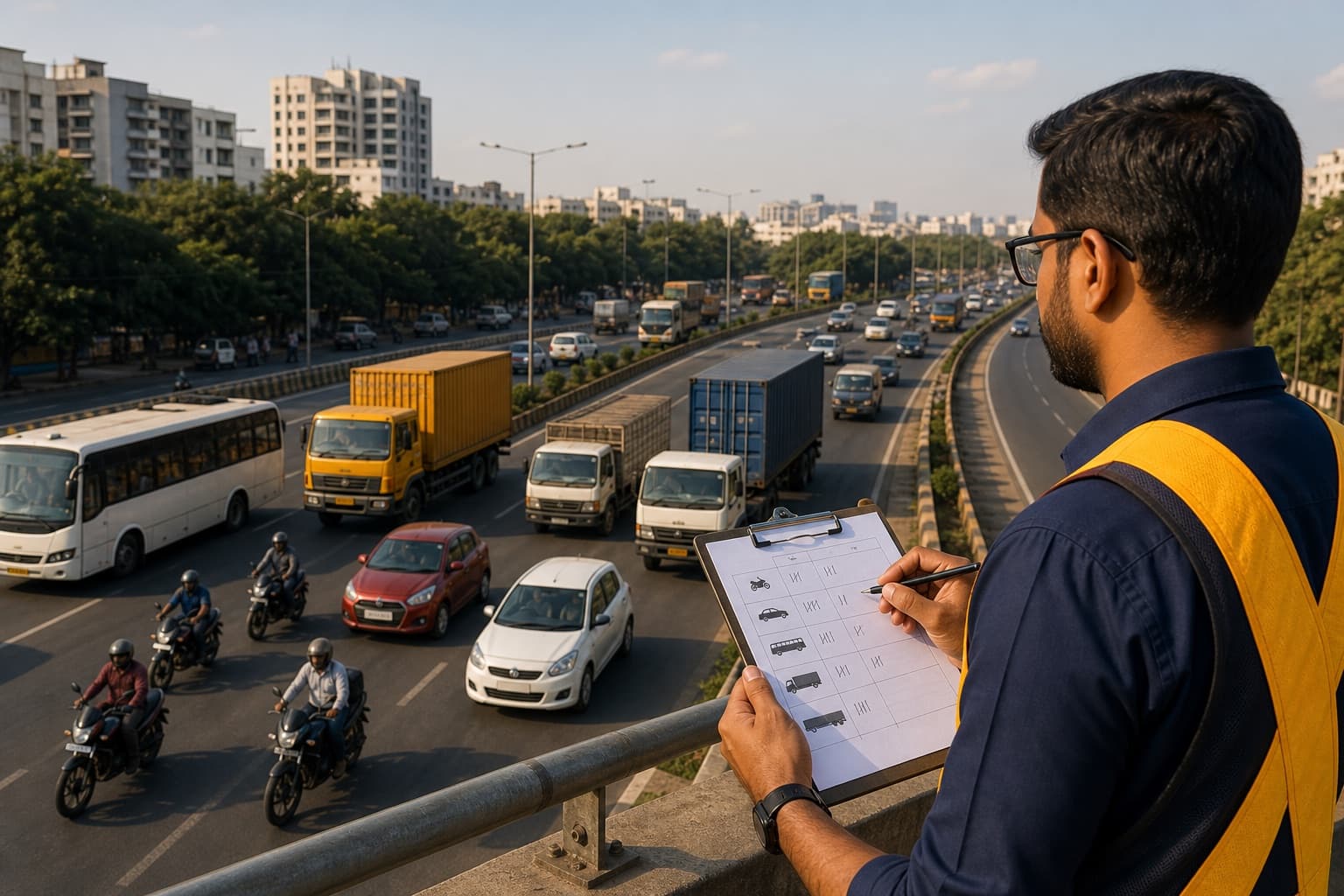
Start with a classification dictionary
State every category, its decision rule, the treatment of edge cases and the reporting columns before collection begins. The same term can mean different things across projects, countries and analytical models, so a named, approved scheme is more useful than an assumed one.
Common category families
Two-wheelers
Motorcycle, motorbike, scooter and moped can be separate classes only where the client’s scheme and the source evidence make the distinction dependable.
Light vehicles
Passenger car, SUV, pickup, van and light commercial vehicle are body-type labels that must be defined in the project dictionary.
Public transport
Bus, minibus and coach can be distinct categories where the study needs them and the observation material supports reliable coding.
Heavy vehicles
Rigid truck, articulated truck and other heavy-vehicle splits should follow the agreed rule. A body-type scheme is not automatically an axle-based scheme.
Body type versus axle-based classification
Body-type categories describe the visible form or use of a vehicle. Axle-based categories use a different rule and may need a source position capable of showing axles reliably. Do not report one as if it were the other, and do not infer an axle count from unclear footage.
Using video without overclaiming certainty
Video can support classification where camera angle, resolution and lighting reveal the characteristics the scheme needs. Occlusion, overlap, night conditions, weather, glare and a narrow field of view can make a class uncertain. The appropriate response is a documented exception rule, a revised class scheme or a different collection method—not a guess.
QA/QC and common errors
- Check class totals against all-vehicle totals for every reporting interval.
- Review a sample of ambiguous or high-volume periods using the agreed rule.
- Confirm labels are consistent across locations, tables and charts.
- Record source limitations and approved exceptions with the delivery.
Frequently asked questions
Can a country-specific class scheme be used?
Yes. Provide the approved scheme or confirm the required convention in the brief; do not assume it from the country alone.
Can motorcycle and scooter be separated?
Only when the scheme requires it and the collection source allows reliable visual distinction.